AI answering service for tree service companies
An AI answering service for tree companies answers calls the owner can't get to, asks the questions a dispatcher would ask, and checks how urgent the situation is before anything else. It collects the caller's name, number, address, and what happened, then routes the ones that need a real person right now while logging everything else for a callback.
What it means
Most missed calls to a tree company happen for the same reason: the owner or the one person who answers the phone is up a tree, on a job site, or asleep at 2am during a storm. An AI answering service is a phone line that is always staffed — it picks up, talks to the caller like a receptionist would, and writes down what matters instead of letting the call go to voicemail.
It is not a chatbot bolted onto a website and it is not a generic call center reading a flowchart. It is built around the questions that actually decide what happens next for a tree job: what fell, where, is anyone blocked in or hurt, and is it touching power lines.
What good looks like
On a well-run setup, every call follows roughly the same shape:
- The caller is greeted, told they're speaking with an AI assistant, and asked what's going on.
- The AI gets the address, a description of the tree or storm damage, and whether it's urgent.
- If it sounds dangerous or time-sensitive, the AI runs the safety check below before collecting anything else.
- Photos get requested only when it's safe for the caller to take them and the company has opted in to collecting photos.
- The details get written down and handed to the crew — nothing sits in a voicemail nobody checks until Monday.
Mistakes to avoid
- Letting a bot quote a price with no price book behind it. A number pulled from nowhere is worse than no number — it sets an expectation the crew then has to walk back on-site.
- Treating a wires call like a normal job. A tree on power lines is a utility emergency, not a scheduling problem. See the safety fork below.
- Assuming “AI answering” means it can text back. Texting a lead requires a registered 10DLC campaign. That isn't live for this product yet, so follow-up today happens by phone.
- No real path to a human for urgent calls. An answering service that only takes a message and stops there is just a nicer voicemail. The transfer/callback step below is what makes it useful.
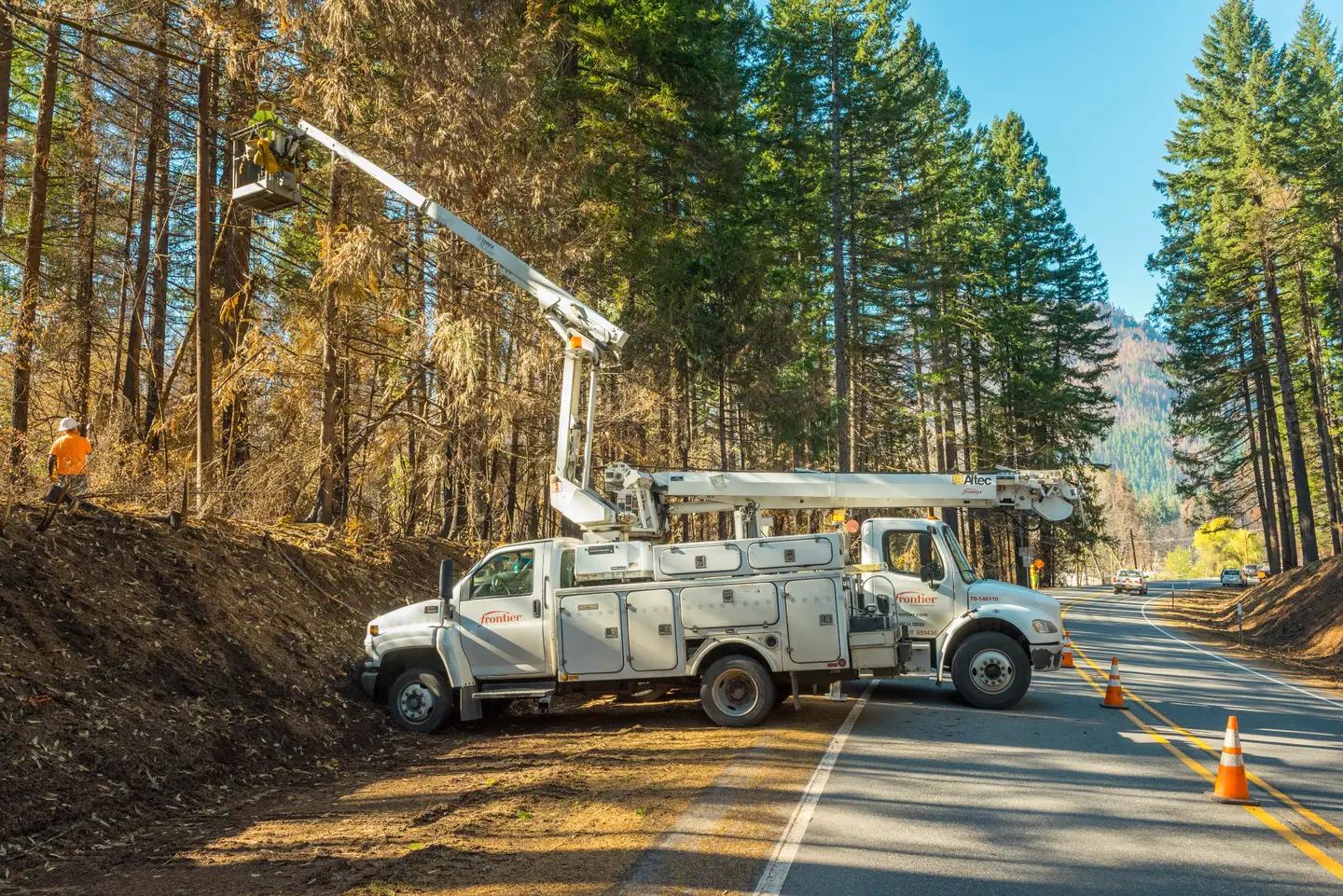
The safety fork: tree on house vs. tree on wires
Tree on a house, shed, fence, or vehicle, clear of power lines: this is squarely a tree company's job. The AI collects what fell, where, whether anyone is trapped or hurt (if so, it tells the caller to call 911 first), and whether it's safe to take a photo. That gets flagged urgent and routed for a callback.
Tree on or near power lines: this is a utility-company job first, every time. The AI tells the caller to stay away from the tree and the lines and to call the utility company (or 911 if anyone is hurt or in immediate danger) before doing anything else. Neither the tree crew nor the AI is positioned to safely clear a tree touching live wires — that call goes to the people who can de-energize the line. The AI still logs the call so the company knows a storm-damage job may follow once the utility has cleared it.
Example: a Saturday-night storm call
A pine comes down across a driveway during a storm, clipping the edge of a carport roof. The homeowner calls at 11pm. The AI answers, confirms nobody is hurt, gets the address and a description, asks if any part of the tree is touching a power line (it isn't), and asks for a photo if it's safe to step outside and take one. It tells the caller a crew member will call back first thing in the morning unless the situation changes, and flags the job as storm-urgent for the on-call list. No price is quoted on the call unless the company has configured one for this exact situation.
How MyCsSite handles it
MyCsSite sets up the AI answering service with each tree company's own service area, urgency rules, and — if they want one — their own price book. No price is ever invented; if a company hasn't configured pricing for the AI to quote from, the AI tells the caller pricing will come from a real person.
The transfer/callback flow is configured per company: an urgent call can trigger an immediate transfer attempt to a live number, or a fast callback with the details already in hand, depending on how the owner wants to run it. The AI is inbound-only — it answers the calls that come in. It does not place outbound calls on the company's behalf, and it does not text (10DLC consent isn't live yet).
This is the same system described on the storm call answering page for the specific case of a flood of calls during severe weather.
FAQ
Does the AI quote a price on the call?
Only if your company has set up its own price book for the AI to read from — it will never invent a number. Without a price book configured, it tells the caller a real person will follow up with pricing.
What happens if a caller says a tree is on power lines?
The AI tells them to hang up and call the utility company (or 911 in a genuine emergency) before anything else — that is a utility-company job, not something the tree crew or the AI handles. It still logs the call as urgent so your team knows right away.
Can the AI text the customer back?
Not yet. Texting requires a 10DLC-registered campaign, which is not live for this product today. Follow-up happens by phone call or however your team already reaches leads.
Does it replace my crew answering the phone?
It answers when you can't — nights, storms, a job site with no signal — and hands you everything it collected. It is inbound-only: it answers calls that come in, it does not place outbound calls on your behalf.
How does an urgent call reach me?
The AI flags the call as urgent based on what the caller describes, then triggers a callback or transfer attempt to a number you set, with the details already captured so you are not starting cold.
See how your calls are being handled today
Tap the towns you think you cover. We will show you what Google shows a homeowner in each one, and email you the one-page report. Free, no call required.
Related: Storm call answering for tree companies · Tree service website design built from proof · Local SEO for tree service companies · What a tree service website should include · Local SEO checklist for tree service companies · Tree service marketing
Questions about your account? Call (855) 317-9090.